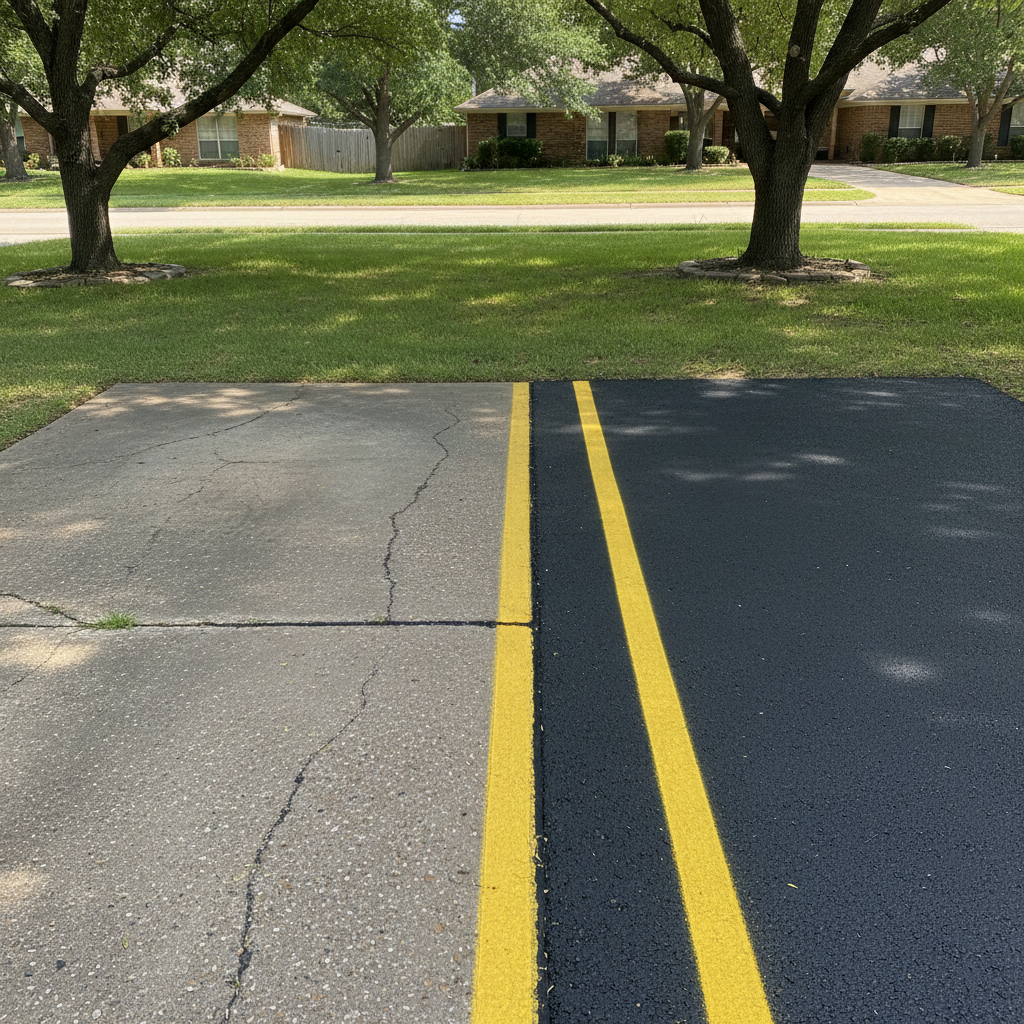
You’ve just had your asphalt driveway paved or sealed, and wow, it looks sharp. But now what about those lines? Maybe you want a basketball court, a parking spot marker, or just some clear boundaries. When it comes to striping, homeowners often just think of one way to do it: paint. But there’s another option worth checking out, especially here in Irving, Texas: thermoplastic.
I’ve seen countless driveways and parking lots over the years, and believe me, the choice between paint and thermoplastic isn’t just about color. It’s really about how long it lasts, how well it stands up to our crazy Texas weather, and what you’re willing to spend now versus later. Let’s break it down, shall we?
The Old Reliable: Traffic Paint
When most folks think about striping, they’re picturing traffic paint. It’s what you see on many roads and older parking lots. This liquid is usually sprayed on with special equipment and dries pretty fast. Here’s the scoop:
- Cost: Paint usually wins here, at least upfront. It’s cheaper to apply per square foot. The materials aren't as expensive, and the application process is generally quicker, which means less labor cost.
- Durability: This is paint’s biggest weakness, especially for us. Our intense summer sun, those sudden downpours, and even the freeze-thaw cycles we get in winter can really beat it up. Paint fades, chips, and wears down much faster than thermoplastic. You’ll often see it looking dull and patchy within a year or two, particularly in high-traffic areas or spots constantly exposed to the sun.
- Maintenance: Since it wears down faster, you’ll be repainting more often. If you want those lines to look crisp, you’re probably looking at a refresh every 1-3 years, depending on traffic and weather exposure.
- Appearance: When it’s fresh, paint looks good. It’s bright and clean. But as it ages, that pop disappears pretty fast. It can also be a bit slick when wet, which is definitely something to think about for driveways where people are walking.
The Tougher Contender: Thermoplastic
Thermoplastic isn’t just paint; it’s a plastic-based material. We heat it to a molten state, then apply it to the asphalt. As it cools, it hardens into a durable, long-lasting layer. Think of it more like a plastic coating, not just a painted surface. Here’s what you should know:
- Cost: Upfront, thermoplastic is more expensive than paint. The material itself costs more, and the application requires specialized equipment and trained crews who know how to handle the heat and precise application.
- Durability: This is where thermoplastic truly shines. It’s incredibly tough. It resists fading from UV rays, stands up to heavy traffic, and handles our extreme temperature swings much better. I’ve seen thermoplastic lines in older neighborhoods like Hackberry Creek still looking good after five, six, even seven years. It bonds really well with the asphalt, becoming almost a part of the surface.
- Maintenance: You won’t be touching these lines nearly as often. While nothing lasts forever, you can expect thermoplastic striping to hold up for 3-7 years, sometimes even longer, before it needs a touch-up or reapplication. That means less hassle and less frequent spending over the long haul.
- Appearance: Thermoplastic lines are thick and vibrant. They have a slightly raised profile, which makes them more visible, especially at night or in wet conditions. They also tend to keep their color and brightness much longer than paint. Plus, it’s not as slick when wet — a nice safety bonus.
So, What’s My Recommendation for Irving Homeowners?
For most homeowners in Irving, especially on a driveway or private lot, I lean towards thermoplastic. I know, I know, the upfront cost is higher. But when you factor in our brutal Texas sun, the occasional ice storm, and the sheer convenience of not having to worry about your lines fading after a year, it’s usually the better investment.
Think about it like this: you can buy cheaper shoes that wear out in a year, or you can spend a bit more on a quality pair that lasts three or four. It’s the same principle here. With thermoplastic, you get a much longer-lasting, more durable, and better-looking result. You’ll save money and headaches on maintenance in the long run.
If you’re just putting down some temporary lines for a kids’ game that you know will change next year, sure, paint might be fine. But for anything you want to last — anything that defines a permanent space or adds to your home’s curb appeal — thermoplastic is the way to go. At All Star Paving, we’ve seen firsthand how much better it holds up.
Ultimately, it’s about making an informed decision that suits your budget and your expectations for how long those lines should last. Don’t just go for the cheapest option; consider the total cost of ownership and the longevity you’ll actually get.